Is the Niagara Falls Jet Boat Safe? Age, Height and Restrictions

Niagara Falls jet boat tours run US Coast Guard certified vessels through Class 5 Devil's Hole rapids, and the operator reports a 100 percent safety record across more than 35 years doing it, but the ride genuinely isn't built for every traveler. In my seasons working Niagara tour boats, the questions I heard most at check-in weren't about the rapids, they were about who's allowed on board at all: how tall does my kid need to be, can I ride pregnant, is this safe with a bad back. This Niagara Falls jet boat age limit and safety guide answers those plainly, with the operator's own numbers, no guessing.

Quick answer
Niagara Falls jet boat tours are statistically very safe: the operator reports a 100 percent safety record across more than 35 years running these Class 5 rapids. It isn't risk-free, and it genuinely isn't for everyone, height, age, weight and a short list of medical conditions all rule some travelers out.
Key takeaways
- Safety record: 100 percent, per the operator, across more than 35 years running Devil's Hole rapids
- Height floor: 44 inches on the open-top wet boat, 40 inches on the domed dry boat
- Top exclusion: pregnancy, not permitted on either boat, no exceptions
- Certification that governs it: US Coast Guard certified vessels and captains (Transport Canada on the Ontario side)
- Who else should think twice: anyone with a history of osteoporosis, heart, neck or back injuries
- Full restrictions table further down covers weight, mobility and chaperone rules
The Safety Record: What the Numbers Say
Last verified: August 2026. The operator reports a 100 percent safety record across more than 35 years of running jet boats through the Niagara Gorge, a claim built on a genuinely long operating history through some of the roughest commercially navigable water in North America. That record puts the activity, in everyday terms, closer to the risk profile of a routine, well-regulated tourist attraction than to unregulated backcountry whitewater rafting.
Vessels are US Coast Guard certified, and every captain holds the certification that governs it, which is the regulatory backbone behind that safety history, not a marketing line standing on its own.
It's worth being direct rather than evasive here: whitewater by its nature carries some risk, and no operator, however careful, can promise a zero-risk ride through Class 5 rapids. What the operating history shows is a long, apparently clean run under continuous federal certification and a mandatory pre-boarding safety orientation for every single rider, not a guarantee, but a genuinely strong track record.
What Makes It Safe: Rules and Certification
Every vessel and captain running the US side out of Lewiston is US Coast Guard certified; the equivalent Ontario departures operate under Transport Canada certification. That's the licensing authority behind the fleet of nine boats, and it's the reason the mandatory safety orientation, participation agreement and 45-minutes-early check-in exist before anyone boards, not paperwork for its own sake.
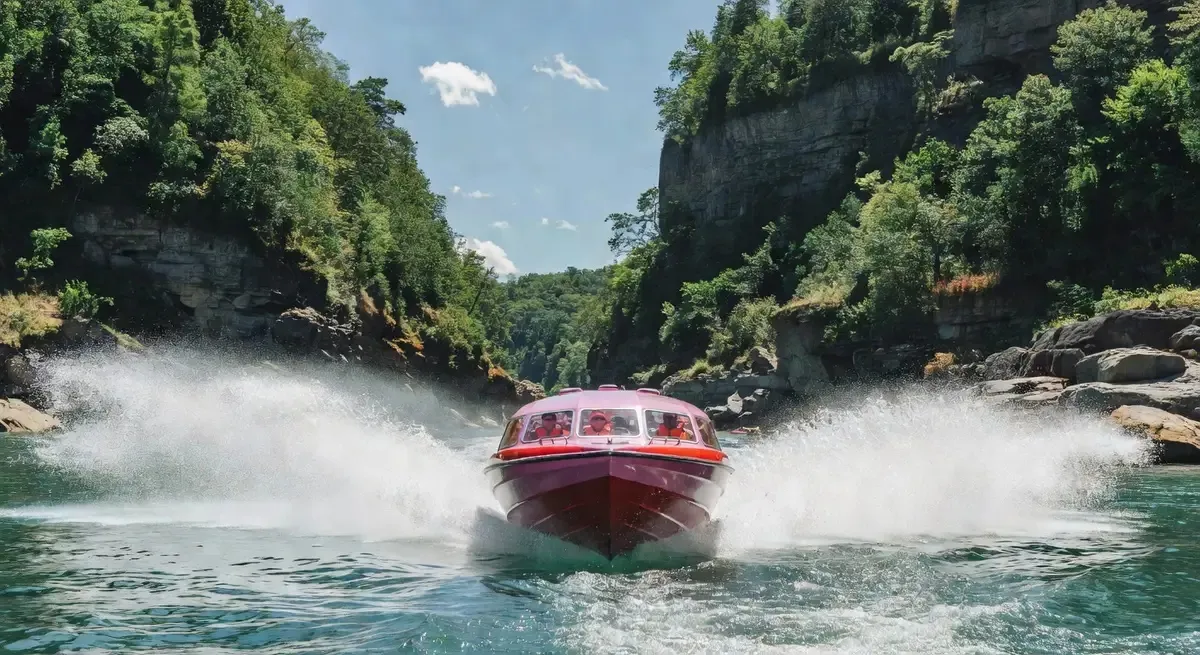
The go/no-go call on any given day comes down to weather and water-level conditions in the gorge; the operator runs daily from April through October and simply doesn't launch when conditions in the Niagara River are unsafe, which is why the season itself has a hard stop each winter as the gorge ices over. Where that leaves the reader is a fair, honest point: regulation and certification set the floor, but which specific boat and crew you book is still worth a moment's thought, covered in the operator-vetting section below.
The Real Risks and How the Crew Manages Them
Four real risk mechanisms are worth naming plainly, each paired with how the operator manages it in practice.
- Cold-water soaking on the open-top boat, especially in spring and fall: managed with splash gear issued on inclement-weather days and complimentary lockers so nothing gets left exposed to the water.
- Getting thrown against a seat or another rider in the roughest stretch of Devil's Hole: managed by keeping riders under 13 or under 100 lbs out of the front power rows, where impacts are hardest, and by the mandatory hold-on briefing everyone sits through before boarding.
- Physical strain from repeated jolts through the rapids for a body with an existing injury: managed through the medical exclusion list, which specifically flags osteoporosis, heart conditions, and neck or back injuries as reasons not to ride.
- Hypothermia risk on a cool shoulder-season day: managed by running the season only from April through October and by issuing splash gear on the days that call for it.
None of these are exotic or hidden risks, they're the ordinary hazards of fast water and a moving vessel, and every one of them has a specific, named mitigation rather than a vague reassurance.
Minimum Age and Height Limits
Children are measured on-site rather than taken at a parent's word, so these are the numbers to plan around, not guarantee.
| Seat type | Minimum | Who it suits |
|---|---|---|
| Open-top wet boat seats | 44 inches | About an average 6-year-old |
| Domed dry boat seats | 40 inches | About an average 4-year-old |
| Front power rows (either boat) | 13 years old AND 100 lbs | Teens and adults only |
| Rear, non-power-row seats | Required for under-13 or under-100-lbs riders | Lighter or younger riders who meet the height floor |
| Front rows, ages 13-15 | Allowed only beside a guest 16 or older, with an adult chaperone (18+) aboard | Teens riding with an older companion |
| Any rider under 18 | Adult chaperone (18+) required aboard | Minors of any age riding the boat |
Who Shouldn't Ride: Restrictions at a Glance
Pulled directly from the operator's own rules, not a generic travel-blog list. See the alternatives section below if one of these rules out your trip.
| Restriction | Rule on these tours | Why it exists | Ask before booking if... |
|---|---|---|---|
| Pregnancy | Not permitted on either boat, no exceptions | Risk of impact trauma from the rapids | You are pregnant or unsure, disclose it before booking, not at the dock |
| Minimum height | 44 inches wet, 40 inches dry dome | Riders below the floor can't be safely secured in the seat | A child is close to the limit, they're measured on-site regardless of what you expect |
| Weight, front-row seating | Under 100 lbs restricted to rear, non-power rows | Lighter riders face a higher ejection risk in the front rows | A younger or smaller rider hopes to sit up front |
| Osteoporosis | Not recommended | Increased fracture risk from repeated jolts | You or a traveling companion has a diagnosis, ask a physician first |
| Heart condition | Not recommended | Sudden, repeated physical strain from impacts | You have any cardiac history, ask a physician first |
| Neck or back injury | Not recommended | Whiplash-style risk from the boat's motion through rapids | You have a recent injury or chronic condition, ask a physician first |
| Mobility limitations | Dock is wheelchair accessible; the boat itself is not, though staff assist boarding | Boat design requires stepping down into open or domed seating | You use a mobility aid, ask staff about boarding assistance in advance |
| Non-swimmers | Fine to ride, a USCG-approved life vest is mandatory for every rider | The vest is the safety net regardless of swim ability | You'd feel more comfortable, ask the crew for reassurance at check-in |
What If Something Goes Wrong
If the ride through Devil's Hole feels rougher than expected
What happens: Class 5 water is genuinely turbulent, and a particularly large wave or hydraulic can hit harder than a rider anticipated. What the crew does: every rider already has a mandatory USCG-approved life vest on and has sat through the pre-boarding safety orientation covering exactly how to brace and hold on. What you do: follow the hold-on instructions from the briefing and stay seated, the crew's job through the roughest stretch is running the boat, not managing panicked movement in the seats.
If a rider feels unwell mid-ride
What happens: motion, cold water and adrenaline can combine badly for some riders, especially anyone who downplayed a medical condition at booking. What the crew does: the captain and crew are positioned to notice a rider in distress and can slow or adjust the ride. What you do: say something immediately rather than waiting it out, this is exactly the scenario the medical exclusion list and honest disclosure at booking are meant to prevent.
If weather shifts after you've already boarded
What happens: conditions in the gorge can change faster than the forecast, which is why the operator already declines to launch when conditions are unsafe. What the crew does: the captain has full authority to adjust the route or return to dock early if conditions call for it. What you do: trust the call, a shortened or altered ride is the safety system working as intended, not a failure of the trip.
Across all three scenarios, the one safety lever that's actually yours to control is honest disclosure and following the briefing: telling the crew about a real medical condition before boarding, and actually listening during the safety orientation instead of tuning it out, does more for your own outcome than anything the operator can do on your behalf.
Safer Alternatives If You're Excluded
If pregnancy, a height floor, or one of the medical exclusions above rules out the jet boat for you or someone in your group, it doesn't have to mean skipping Niagara Falls itself. The Maid of the Mist and Cave of the Winds day tour gets you close to the falls on a calmer, enclosed boat and a walking tour, with none of the jet boat's physical intensity, and the all-inclusive USA tour folds in a full day of sightseeing at an easier pace. Neither replaces the jet boat's thrill, but both are genuine, well-reviewed ways to see the falls if the jet boat's own rules exclude you, subject to those tours' own booking rules for pregnancy and young children.
Frequently Asked Questions
Is the Niagara Falls jet boat safe?
Statistically, yes. The operator reports a 100 percent safety record across more than 35 years running Class 5 rapids, under continuous US Coast Guard certification. It isn't risk-free, whitewater by nature carries some, and it isn't suitable for everyone, but the operating history and mandatory safety orientation reflect a genuinely careful operation.
What is the minimum age for the Niagara Falls jet boat?
There's no strict minimum age on its own, height is the real gate: 44 inches for the open-top wet boat, 40 inches for the domed dry boat's seats. Anyone under 18 needs an adult chaperone (18+) aboard regardless of height.
How tall does a child have to be for the jet boat?
44 inches for the wet boat, about an average 6-year-old, or 40 inches for the domed dry boat's dome seats, about an average 4-year-old. Children are measured on-site at check-in, not taken at a parent's estimate.
Can you ride the Niagara Falls jet boat pregnant?
No. Pregnant riders are not permitted on either boat, with no exceptions. If a jet boat ride was on your Niagara itinerary, our safer alternatives covers calmer boat and sightseeing options instead.
Can seniors ride the Niagara Falls jet boat?
There's no upper age limit stated by the operator, but the same medical exclusions apply regardless of age: a history of osteoporosis, heart conditions, or neck or back injuries are all reasons to talk to a doctor first or reconsider. Otherwise, an older rider in good health can ride the same as anyone else.
What happens if someone falls in the water?
Every rider wears a mandatory USCG-approved life vest for the entire ride specifically for this reason, and the crew's pre-boarding safety orientation covers exactly how to hold on through the roughest water. The captain has full authority to slow the boat or adjust the route if conditions or a rider's safety call for it.
Most riders sail through these rules without a second thought, and for them the jet boat is exactly as safe as the operator's record suggests. For the smaller group this page is really written for, height, pregnancy, or one of the medical exclusions above, the honest answer is to book a different Niagara experience rather than push a boundary the operator itself sets for a reason. Either way, the same compare wet and dry boat tours breakdown on the homepage covers every option we track before you book.